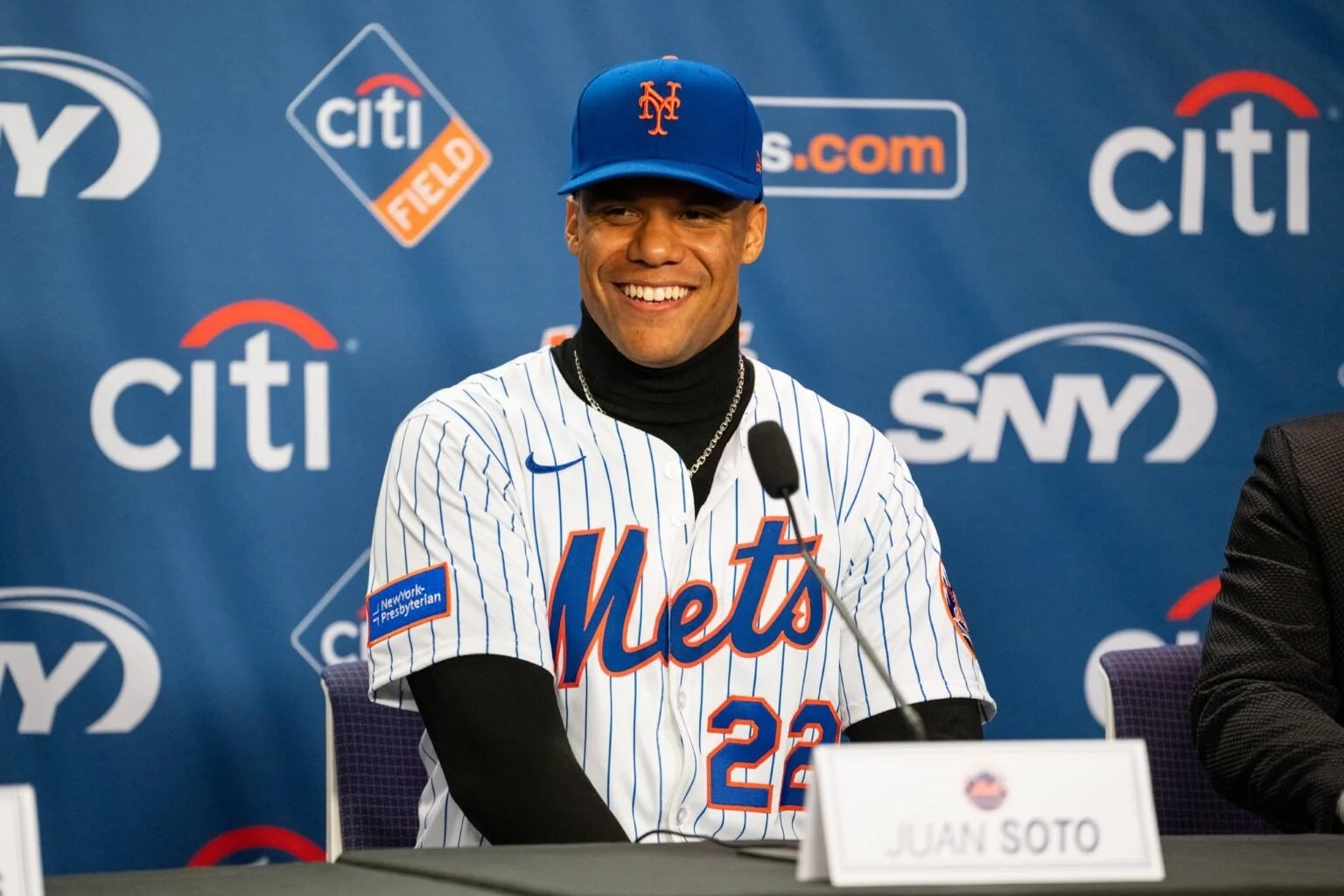
Juan Soto to the Mets: Contract Case Study
In January 2025, Juan Soto signed a 10-year, $325 million contract with the New York Mets, marking one of the most significant free agent signings in baseball history — not just for the size of the deal, but for the context in which it happened. After spending a single season with the New York Yankees, where he delivered superstar production and made a World Series appearance, Soto walked across town and joined their crosstown rival in what immediately became one of the most dramatic power shifts in modern MLB free agency.
The move came after Soto had signed a record-breaking 1-year, $31 million arbitration deal with the Yankees in early 2024 — the highest one-year salary ever for an arbitration-eligible player. It was a stopgap agreement, designed to avoid arbitration and let Soto hit the open market at age 26 — the prime of his career. This free agent contract was the culmination of a long-term plan carefully executed by Scott Boras, prioritizing flexibility, leverage, and timing to perfection.
CONTRACT TERMS
Team: New York Mets
Date Signed: January 2025
Length: 10 years
Total Value: $325 million
Annual Average Value (AAV): $32.5 million
Agent: Scott Boras
Opt-Out Clause: After Year 4
No-Trade Clause: Full
Bonuses: MVP voting escalators, All-Star incentives, postseason performance bonuses
Historical Note: Highest contract ever given by the Mets; one of the top 10 largest contracts in MLB history
THE LEGAL & NEGOTIATION ANGLE
This contract was the final stroke of a long-game negotiation arc that began before Soto ever stepped on the field in Yankee pinstripes. After turning down a reported $440 million extension from the Nationals in 2022, Soto was traded to the Padres, then to the Yankees in 2023. He and Boras refused to sign any long-term deal during that stretch — instead, they preserved his right to hit free agency at the youngest possible age, with maximum leverage.
That leverage peaked in early 2024 when Soto and the Yankees agreed to a 1-year, $31M arbitration settlement — the richest in history. But the Yankees' failure to lock him up long-term proved fatal. Despite a monster 2024 season in the Bronx, negotiations reportedly stalled over contract length and deferrals. Enter Steve Cohen and the Mets.
The Mets’ offer included everything Boras wanted: top-of-market money, an opt-out clause after four years, and a full no-trade clause, which gives Soto ultimate control over his future. The contract also includes performance-based escalators that could push the total value higher. Unlike other mega-deals, this one avoided extensive deferrals and front-loaded payments for early peak years — ideal for tax and valuation purposes.
Legally, the opt-out clause after Year 4 was the crown jewel of the negotiation. It ensures that if Soto’s market continues to rise — or if the Mets falter as a contender — he can re-enter free agency at age 30, still in his prime.
IMPACT ON THE GAME
This deal sent shockwaves through baseball for multiple reasons:
It was the biggest rival-to-rival signing in decades, reviving the dormant Yankees–Mets rivalry overnight.
It reaffirmed that Scott Boras still dominates the free agency space, especially when dealing with big-market, big-budget owners.
The deal also reinforced a new model of superstar control: younger free agents negotiating massive deals with player options baked in early. Soto’s contract gives him everything — security, control, leverage, and a future door to re-enter the market. It also set a precedent for top-tier hitters in their mid-20s to push for shorter commitments with built-in opt-outs, instead of locking into 12–14 year mega-deals with heavy deferrals.
CONTROVERSY & FALLOUT
For Yankees fans and front office brass, this was a brutal loss. The team traded top prospects to acquire Soto, watched him rake for a year, and then lost him to their city rival without a return. Reports indicated that the Yankees were unwilling to go to 10 years or match the structure Boras demanded. Internal tension about long-term luxury tax implications — and a refusal to include a full no-trade clause — reportedly sank the deal.
Critics questioned whether the Yankees had mishandled the timing, failing to push hard for an extension early in the 2024 season. Some argued that not including even a soft opt-out offer showed a misread of player leverage and modern contract trends.
On the Mets side, the deal was seen as a flex — proof that owner Steve Cohen is building a long-term contender and isn’t afraid to weaponize capital to do it. But the pressure is real: anything short of a postseason run in the next two years will magnify scrutiny on both the contract and the franchise.
KEY TAKEAWAYS
Age = Leverage: Hitting free agency at 26 gave Soto unmatched power — teams weren’t just paying for performance, they were buying prime years.
Structure Wins: Opt-out clauses and no-trade protection are becoming just as valuable as total dollars.
Bridge Deals Can Work: The $31M arbitration deal wasn’t just a record — it was a calculated setup for this payday.
Rival Movement Matters: Soto’s departure from the Yankees to the Mets will define this era of New York baseball.
The Boras Blueprint: Refuse early extensions, preserve free agency access, and demand elite structure — even in a high-pressure market like NYC.